
Architecture guide
6 minHow do you reduce noise in an office: which ceiling and acoustic panels should you use?
Which surface to treat first, what NRC means, which ceilings and panels absorb most (perforated Tile Lay-In, Heartfelt felt, acoustic clouds, wall linings) and the difference between absorbing and isolating sound.
By the LuxaLine · Grupo ConstruMarket team · Updated
The short answer
Start with the ceiling, because it's the largest, most open surface in an office: an absorbent ceiling, NRC 0.70 or higher, cuts the echo across the whole floor. Then treat the walls where sound bounces —glass, parallel walls, the screen wall in meeting rooms— with acoustic panels, and if the ceiling can't be closed, hang clouds or islands. Mind the difference: absorbing removes echo inside the space; isolating stops voices reaching the next room, and that's solved with walls that run up to the slab, not with the ceiling. In the catalogue, Tile Lay-In perforated reaches up to NRC 0.95, Heartfelt felt ranges from 0.40 to 0.95 and acoustic clouds are rated NRC 0.65.

Absorbing is not isolating
Noise bothers people in an office in two ways. The first is echo: voices bounce off the ceiling, the glass and the hard floor, add up to everyone else's and people end up talking louder. That's fixed with absorption: porous or perforated materials with a fleece behind them that «swallow» part of the sound instead of returning it. The second is lack of privacy: what's said in one room is heard in the next. That's isolation, and it depends on the mass and continuity of the wall.
NRC (noise reduction coefficient) measures absorption, from 0 to 1: a material rated NRC 0.70 absorbs about 70% of the sound that reaches it. It doesn't measure isolation. That's why a high-NRC ceiling greatly improves an open office but won't stop a conversation being heard over a wall that stops at ceiling height: the sound travels through the plenum.
What to treat first, in order
| Surface | Why | What to use | Spec-sheet data |
|---|---|---|---|
| 1 · Ceiling | It's the largest surface and receives sound from the whole floor | Perforated Tile Lay-In, Heartfelt, 300L and B-line linear ceilings | Tile Lay-In up to NRC 0.95 · Heartfelt 0.40–0.95 |
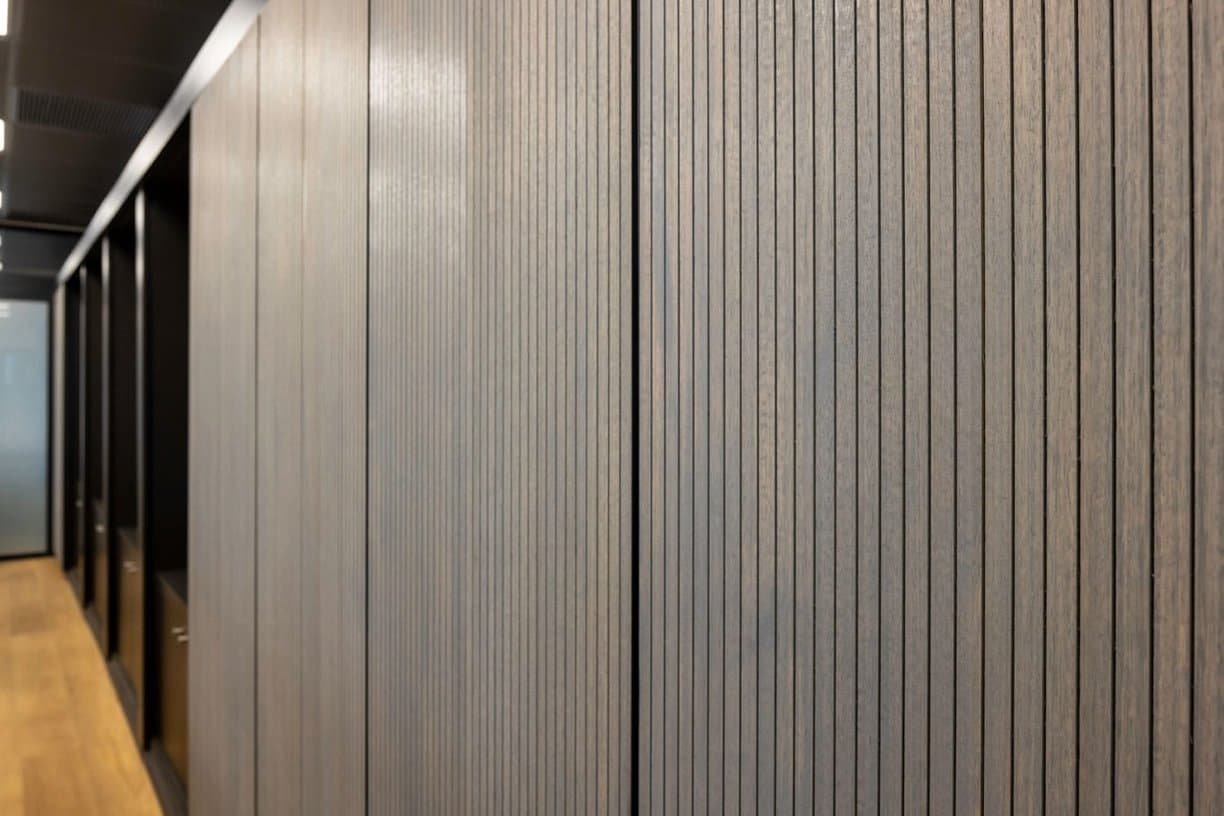
| 2 · Hard or parallel walls | Between two parallel walls sound bounces back and forth | Natura–Patagonia Acoustic, Bamboo Interior Wall Panel | «High NRC» · «acoustic absorption» (see sheet) |
| 3 · A ceiling that can't be closed | Exposed slab, double height or exposed services | Acoustic clouds, wood clouds and islands | Acoustic clouds NRC 0.65 |
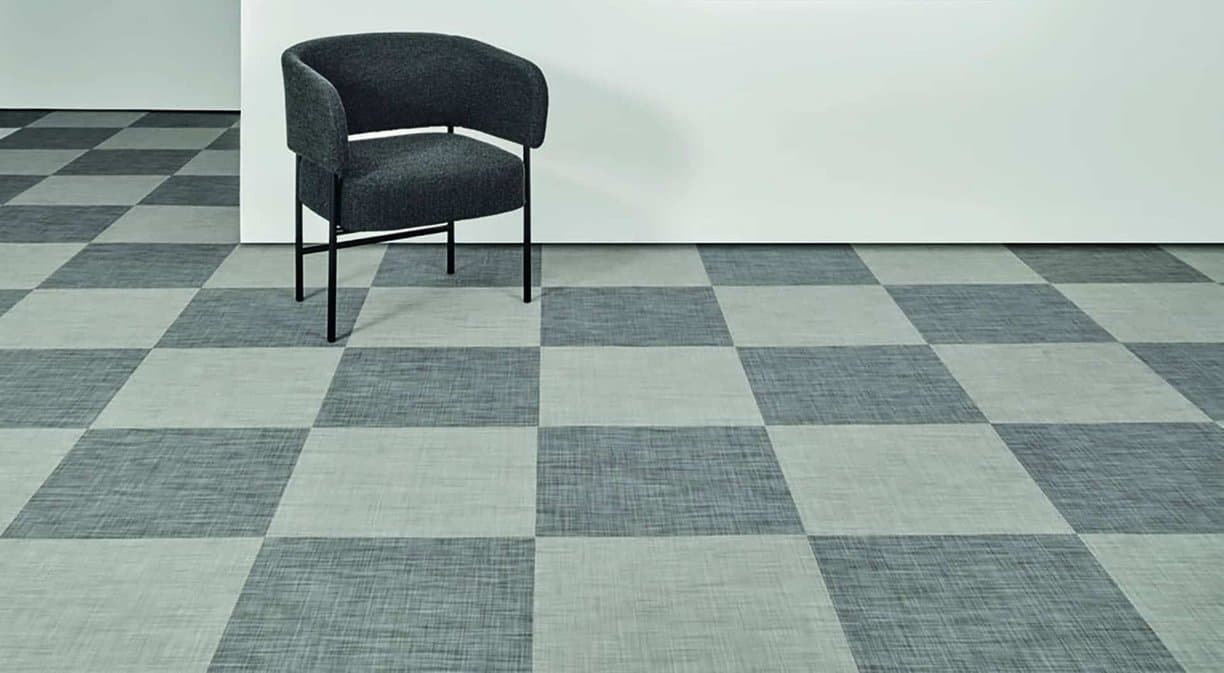
| 4 · Floor | Footsteps, heels and chairs being dragged | Vertisol Tessitura, woven vinyl | «Acoustic absorption» (see sheet) |
Actual absorption depends on the perforation, the acoustic fleece and the area treated. Ask for each line's spec sheet before comparing.
What each space needs
- Open-plan office: an absorbent ceiling over the whole area and panels on the walls nearest the desks that are on the phone. The workstation divider panel cuts direct voice between neighbours.
- Meeting room with video calls: an absorbent ceiling and panels on at least one wall of each parallel pair. The microphone picks up echo you no longer notice.
- Double-height reception or lobby: clouds hung over the spots where people stop to talk.
- Dining area or cafeteria: an absorbent ceiling and a floor that doesn't add impact noise; they're the loudest spaces in an office building.
- Call centre: all of the above, plus the desk layout explained in the guide on call centre furniture.
Where to see it: projects in the region
LuxaLine Arquitectura, the architectural division of Grupo ConstruMarket, is an authorized Hunter Douglas distributor in El Salvador, Guatemala, Nicaragua and Panama: it specifies, supplies and installs as an integrated package, with the group supervising every project.
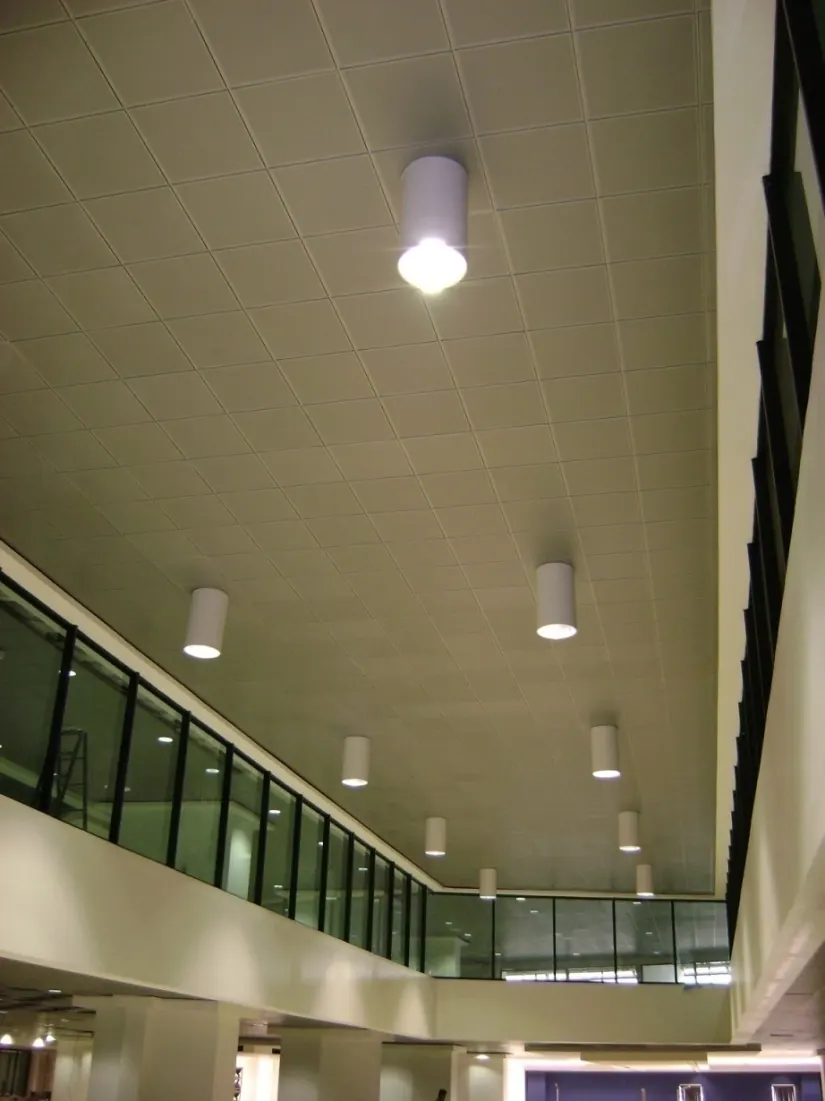
- La Aurora International Airport (Guatemala): the perforated Tile Lay-In absorbs the noise of a long, hard space, and the modular grid keeps services accessible.
- Centro Comercial Galerías (El Salvador): Baffle 100 ceiling at 150 spacing in the food court.
- Millennium (El Salvador): linear wood ceilings in circulation areas and lobby, and metal baffles in the double-height spaces.
Coordinate before installing
An acoustic ceiling lives with light fittings, air diffusers, sprinklers and cameras. Draw the reflected ceiling plan before buying so nothing lands mid-tile, and remember Central America is a seismic zone: suspended ceilings need bracing, and there are seismic ceiling systems. If you're also choosing the type of ceiling, the guide on suspended ceilings compares lay-in, linear and open ceilings.
On video
We explain it in a minute
Common mistakes
Wall panels under a hard ceiling
The ceiling is the largest surface. If it keeps reflecting, the wall panels fall short.
Expecting the ceiling to isolate rooms
Voices travel over the wall through the plenum. For privacy, the wall runs up to the slab.
Choosing on looks without asking for NRC
Two ceilings that look the same can absorb very differently depending on perforation and fleece. Ask for the sheet.
Laying out without coordinating lights and air
Cutting tiles to fit a diffuser leaves gaps that don't absorb and a patched ceiling.
Frequently asked questions
Which suspended ceiling suits an office with noise problems?
An absorbent one, NRC 0.70 or higher: a perforated metal lay-in with acoustic fleece (Tile Lay-In reaches NRC 0.95), a felt ceiling such as Heartfelt (0.40 to 0.95) or acoustic clouds (NRC 0.65) where the ceiling can't be closed.
What is the NRC of an acoustic material?
It's the noise reduction coefficient: it runs from 0 to 1 and indicates what fraction of sound the material absorbs. NRC 0.70 means it absorbs about 70%. It measures absorption, not isolation.
Does an acoustic ceiling stop sound reaching the next room?
Not on its own. The acoustic ceiling removes echo inside the room; to stop voices passing through, the wall between rooms must run up to the slab and be sealed.
Where should acoustic panels go in a meeting room?
Ceiling first; then panels on at least one wall of each pair of parallel walls, especially if one is glass. That cuts the bounce the microphone picks up on video calls.
Who installs Hunter Douglas acoustic ceilings and panels in Central America?
LuxaLine Arquitectura, from Grupo ConstruMarket, an authorized Hunter Douglas distributor in El Salvador, Guatemala, Nicaragua and Panama. It specifies, supplies and installs as an integrated package with the group supervising every project. Request a quote at luxaline.net/en/proyecto.
Where to see it in the catalogue
Does your office have echo or too little privacy?
Tell us which space it is, its size and whether the problem is echo or sound carrying between rooms. We'll propose the ceiling, panels and installation as an integrated package.
An advisor gets back to you during business hours.