
Architecture guide
6 minLay-in, linear or metal: which suspended ceiling should you choose?
Mineral-fibre and metal lay-in ceilings, linear ceilings like the 84R, baffles and open cells: which fits by access, acoustics (NRC) and humidity. With real projects in the region.
By the LuxaLine · Grupo ConstruMarket team · Updated
The short answer
It depends on three things: how often you need to reach the services above, how much noise must be absorbed and how humid the space is. A lay-in ceiling —tiles or trays resting on a suspended grid— gives the easiest access: lift one piece and you reach the duct. A linear metal ceiling, like the 84R Linear Ceiling (84.5 mm wide panels up to 5 m long), reads as a continuous surface and handles humidity better than mineral fibre. Open ceilings —baffles and cells— leave the plenum visible and are used when the ceiling is part of the design. In short: mineral-fibre lay-in for dry offices on a tight budget; perforated metal lay-in for concourses, humid or high-traffic areas; linear or baffle when the architecture calls for character.
The four families, in one table
| Family | What it is | Access | Humidity | In the catalogue |
|---|---|---|---|---|
| Mineral-fibre lay-in | Tile resting on an exposed grid | Full, tile by tile | Low: it sags with moisture | Dune, Cortega, Ultima, Fashiontone, Clean Room VL |
| Metal lay-in | Metal tray on a grid, plain or perforated | Full | High | Tile Lay-In, Tile Lay-In MetalScreen |
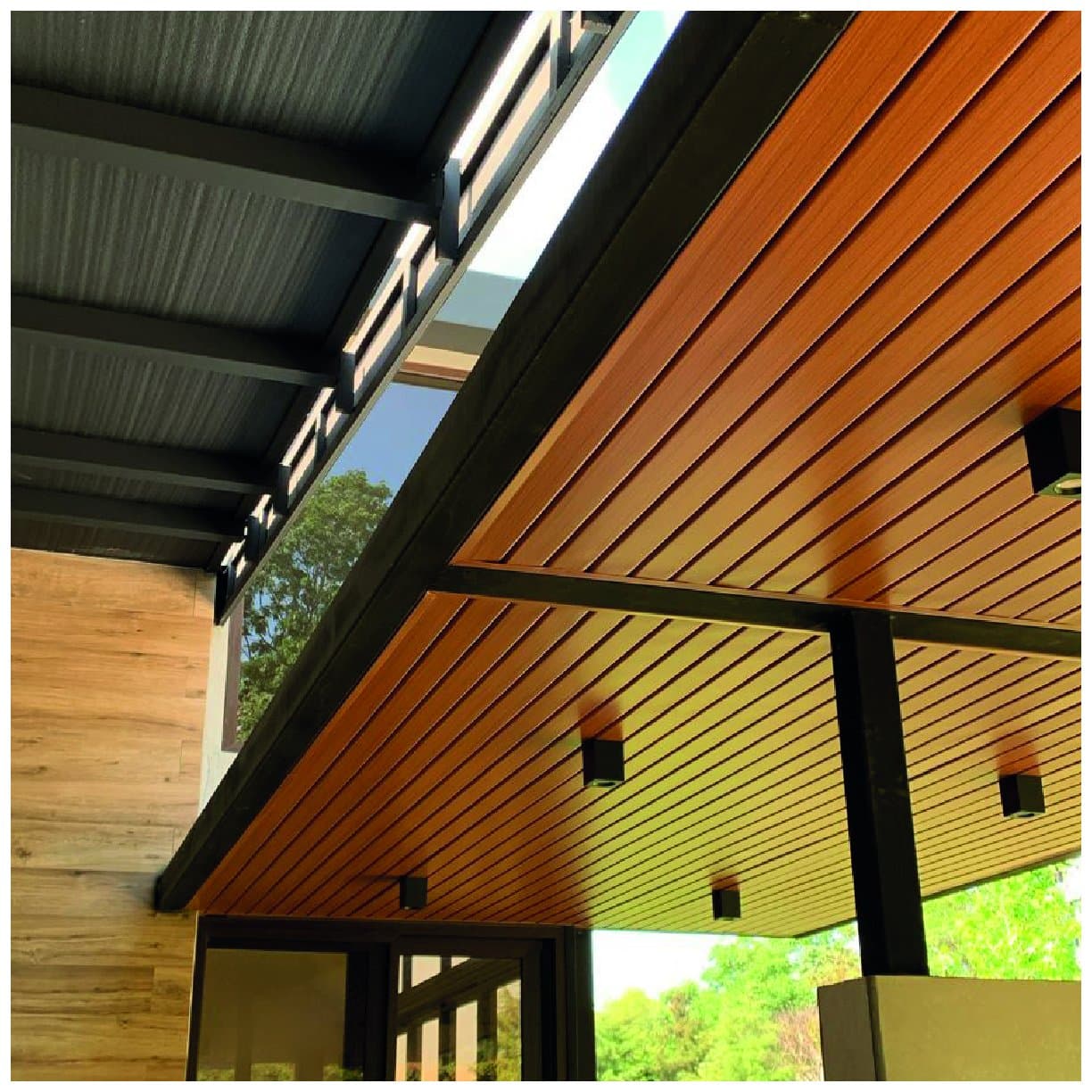
| Linear metal | Long panels clipped to a carrier | Panel by panel | High | 84R, 300C / 375C / 450C, U25, 300L |
| Open (baffle / cell) | Blades or an open grid | Through the ceiling | High | Baffle (50–150 mm), Cell family, Multicell |
Each line has its spec sheet in the catalogue; actual absorption depends on the perforation and acoustic fleece specified.
What exactly is a lay-in ceiling (and how it differs from snap-in)
«Lay-in» means the piece simply rests on the profiles of a T-grid hung from the slab. The most common modules are 60 × 60 cm (or 61 × 61, the 2 × 2 ft equivalent) and 60 × 120 cm. Since nothing is fixed, any tile lifts out by hand, which is why it's the ceiling of offices, hospitals, airports and retail, where electricians and HVAC technicians go up several times a year.
The Tile Snap-in looks different: the tray clips onto a concealed suspension system with a minimal joint, so the ceiling reads almost as one plane. Plank Hook-on hang long trays from a carrier and suit wide spans. Rule of thumb: if you'll access the plenum often, lay-in; if aesthetics and a monolithic look rule, snap-in or hook-on.
Acoustics: NRC in plain words
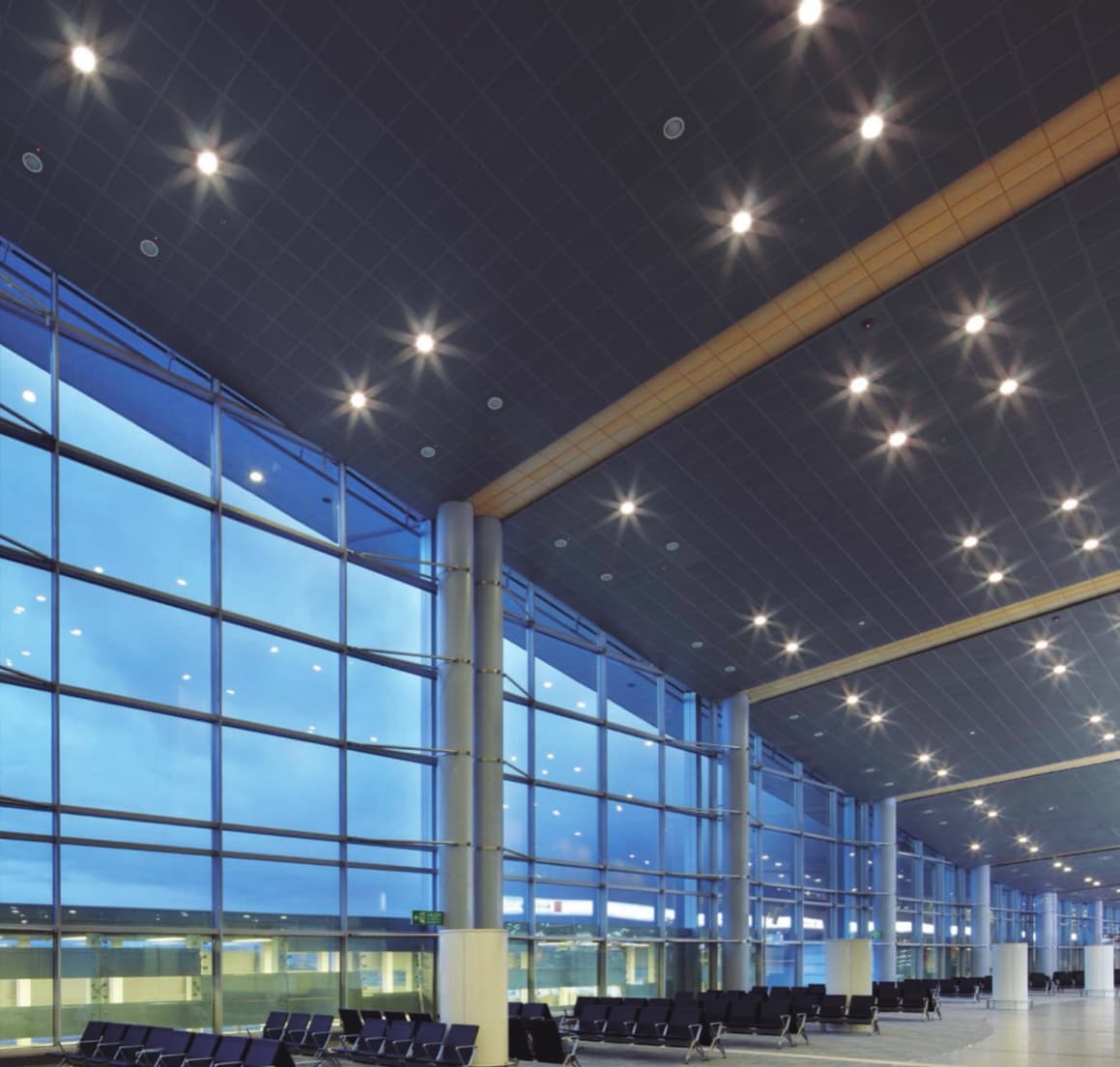
NRC (noise reduction coefficient) runs from 0 to 1 and tells you what fraction of sound the material absorbs: 0.70 means it absorbs about 70%. Open offices, classrooms and meeting rooms usually aim for 0.70 or more. A plain metal ceiling reflects sound; perforated with an acoustic fleece behind it, it absorbs: the Tile Lay-In reaches up to NRC 0.95 depending on its perforation. Heartfelt felt ranges from 0.40 to 0.95 and the acoustic clouds have NRC 0.65: they help when you can't close the whole ceiling, as in double-height lobbies or auditoriums.
Humidity, earthquakes and maintenance
Mineral fibre absorbs moisture: in kitchens, restrooms, car parks, semi-open areas or buildings without constant air conditioning it sags and stains. There, metal (aluzinc or aluminium) is the better choice. For labs and healthcare there are mineral-fibre tiles with a smooth, washable face, such as the Clean Room VL. Central America is a seismic zone: a suspended ceiling needs bracing and perimeter details designed for the site, and the range includes seismic ceiling systems. Also coordinate light fittings, diffusers and sprinklers with the ceiling module from the drawings: a diffuser that lands mid-tile forces cuts and leaves a patched ceiling.
Where to see it: projects in the region
LuxaLine Arquitectura, the architectural division of Grupo ConstruMarket, is an authorized Hunter Douglas distributor in El Salvador, Guatemala, Nicaragua and Panama: it specifies, supplies and installs as an integrated package, with the group supervising every project.
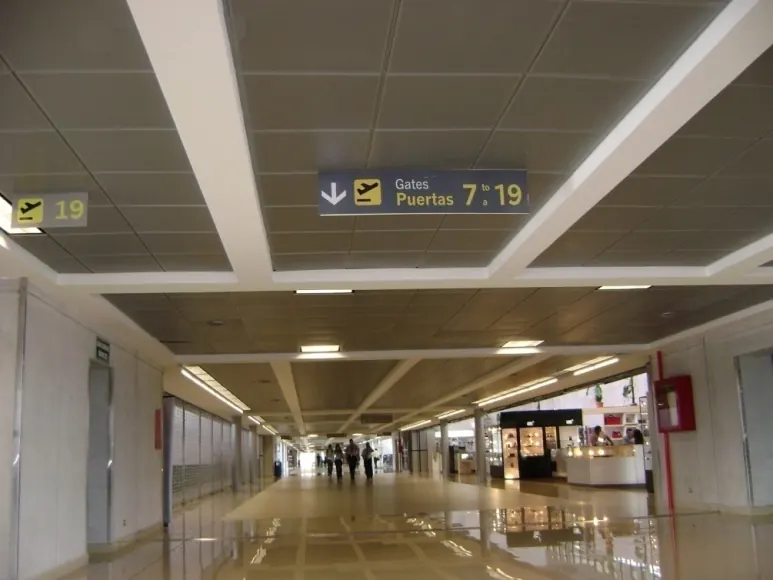
- La Aurora International Airport (Guatemala): perforated Tile Lay-In ceiling in the concourses. The perforated tile absorbs the noise of a long, hard space, and the modular grid keeps services accessible.
- Centro Comercial Galerías (El Salvador): Baffle 100 ceiling at 150 spacing in the food court and ACM Luxaline on the ceilings.
- Millennium (El Salvador): linear wood ceilings in circulation areas and lobby, and metal baffles in the double-height spaces.
Common mistakes
Mineral fibre in a humid zone
It sags and stains within months. In restrooms, kitchens, car parks and semi-open areas, use a metal ceiling.
Choosing without coordinating lights and diffusers
If they don't land on the module, tiles get cut. Draw the reflected ceiling plan before you buy.
Forgetting seismic bracing
Earthquakes happen here. A suspended ceiling needs bracing and perimeter details designed for the site.
Comparing only price per square metre
A ceiling that's hard to access costs money every time someone goes up. Add the maintenance of the coming years.
Frequently asked questions
What is a lay-in ceiling?
It's a suspended ceiling whose tiles or trays rest on a T-grid hung from the slab, in modules such as 60 × 60 or 60 × 120 cm. Each piece lifts out by hand, so it offers the easiest access.
What's the difference between a lay-in and a snap-in ceiling?
In a lay-in ceiling the tile rests on an exposed grid; in a snap-in ceiling the tray clips onto a concealed suspension with a minimal joint. Lay-in is quicker to access; snap-in looks more continuous.
Which suspended ceiling handles humidity?
Metal ceilings in aluzinc or aluminium, whether lay-in, linear or baffle. Mineral fibre sags with moisture and only suits dry, air-conditioned interiors.
What NRC does an office ceiling need?
Open offices, classrooms and meeting rooms usually aim for NRC 0.70 or higher. In the catalogue, perforated Tile Lay-In reaches up to 0.95 and Heartfelt felt ranges from 0.40 to 0.95.
What is the 84R metal ceiling?
It's a Hunter Douglas linear metal ceiling in aluzinc or aluminium, with 84.5 mm wide panels up to 5000 mm long, which can be curved. It reads as a continuous surface and handles humidity.
Who installs Hunter Douglas ceilings in El Salvador?
LuxaLine Arquitectura, from Grupo ConstruMarket, an authorized Hunter Douglas distributor in El Salvador, Guatemala, Nicaragua and Panama. It specifies, supplies and installs as an integrated package with the group supervising every project. Request a quote at luxaline.net/en/proyecto.
Where to see it in the catalogue
Got the ceiling plan or the area?
Send us the plan or the square metres, how the space is used and whether there's humidity. We'll propose the system, the acoustics and the installation as an integrated package.
An advisor gets back to you during business hours.