
Architecture guide
5 minLinoleum, LVT or sheet vinyl: which floor stands up to heavy traffic?
How to choose between linoleum, homogeneous sheet vinyl and LVT for hospitals, schools, offices and retail: use class, subfloor, seams and maintenance.
By the LuxaLine · Grupo ConstruMarket team · Updated
The short answer
For heavy traffic and daily cleaning, homogeneous sheet vinyl is the toughest: the colour runs through the full thickness, so wear never reveals another layer, and the seams are heat-welded so water and dirt can't get in; that's why it's the floor of hospitals, labs and school corridors. LVT (luxury vinyl tiles and planks) looks like wood or stone and can be replaced piece by piece; for heavy traffic choose the line rated for it, such as LVT Creation 70. Linoleum is a natural, 100% recyclable material, warm underfoot and widely used in classrooms, offices and libraries, but it doesn't belong in permanently wet areas. At LuxaLine, an authorized Hunter Douglas distributor in El Salvador, Guatemala, Nicaragua and Panama, you'll find all three.
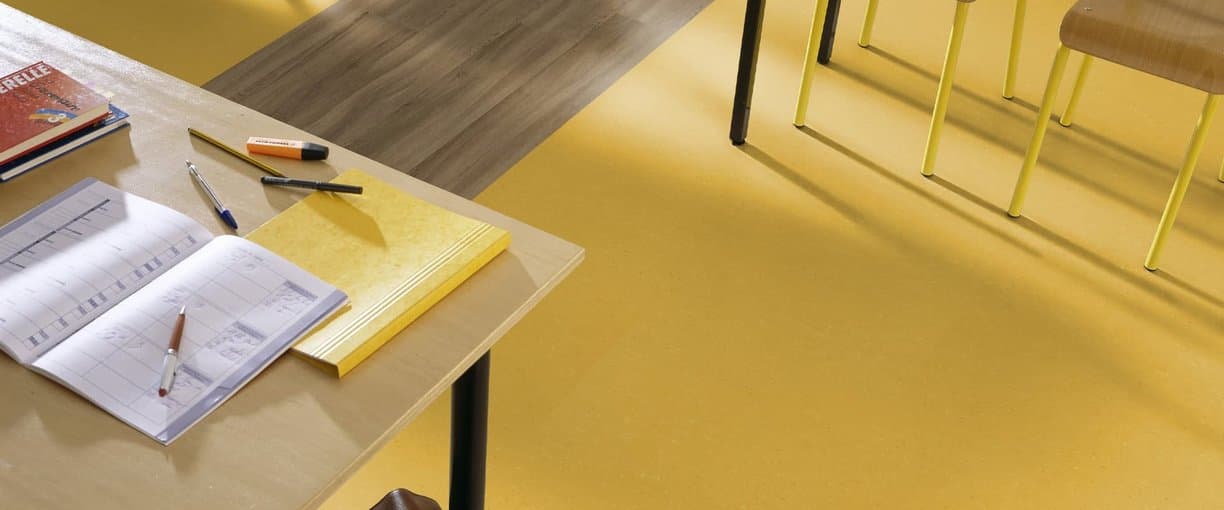
The floors, compared
| Floor | What it is | Strong at | Watch out for | In the catalogue |
|---|---|---|---|---|
| Homogeneous sheet vinyl | A single layer; colour runs through the full thickness | Hospitals, labs, corridors, schools | Needs a very level subfloor and a specialist installer | Mipolam Affinity, Mipolam Robust EL7 |
| LVT | Tiles or planks with a clear wear layer over a design | Retail, offices, hospitality; replace piece by piece | The wear layer sets the service life | LVT Creation 30, 40, 55 and 70 |
| Linoleum | Natural material on a jute backing | Classrooms, offices, libraries, healthcare | Standing water and highly alkaline cleaners | DLW linoleum |
| Woven vinyl | Vinyl textile with a carpet look | Offices and rooms that need acoustics | Choose the weave for the traffic level | Vertisol Tessitura (with sound absorption) |
How to read the spec sheet: use class and wear layer
Resilient floors are classified by use intensity under EN ISO 10874: class 2x is residential, 3x commercial and 4x light industrial; within each group, the second digit rises with traffic (34 is very heavy commercial). Ask for the use class on the spec sheet and compare it with your space: a hospital corridor or a mall lobby is not a private office. With LVT, also check the wear-layer thickness: it's what wears away, and what decides how many years the floor looks good.
The subfloor decides half the outcome
Most failures in vinyl and linoleum floors don't come from the floor but from what's underneath: a damp slab lifts the adhesive and creates bubbles, and an uneven slab shows every flaw against the light. Before installing, the slab must be cured, dry to the reading the manufacturer requires, clean and levelled with self-levelling compound if needed. In renovations, remove the old floor or confirm the new one can go on top.
Which floor for each space
- Hospitals and clinics: homogeneous sheet vinyl with heat-welded seams and a coved sanitary skirting, so there are no corners where dirt collects.
- Schools and universities: linoleum in classrooms and libraries; homogeneous vinyl in corridors and labs.
- Offices: LVT for looks and piece-by-piece replacement, or linoleum; woven vinyl where acoustics matter.
- Retail and hospitality: LVT from the heavy-traffic line; in warm lobbies, also MOSO bamboo.
Maintenance
Daily sweeping or vacuuming and mopping with a neutral cleaner cover almost everything. Linoleum needs neutral pH: highly alkaline cleaners and solvents damage it. On all of them, a long entrance mat traps the grit that scratches the surface, and felt pads on chair and table legs prevent marks. For the rest of the furniture, see the guide on maintenance.
Common mistakes
Installing on a damp slab
The adhesive lets go and bubbles appear. Measure slab moisture before installing.
Linoleum in restrooms or commercial kitchens
Standing water damages it. There, homogeneous vinyl with heat-welded seams.
Residential LVT in a store
It looks the same in month one. Ask for a commercial use class on the spec sheet.
Open seams in a healthcare area
Every seam is a place where dirt builds up. In healthcare, sheet flooring with heat-welded seams.
Frequently asked questions
What is linoleum and how is it different from vinyl?
Linoleum is a floor made from natural components on a jute backing; vinyl is a synthetic material. Linoleum is warm and recyclable but doesn't tolerate standing water; homogeneous vinyl resists moisture and its seams are heat-welded.
Which floor is best for hospitals and clinics?
Homogeneous sheet vinyl with heat-welded seams and a coved sanitary skirting: it leaves no open joints and withstands daily cleaning and disinfection.
Does LVT stand up to heavy traffic?
Yes, if you choose a line with the right use class and a thick wear layer. In the LuxaLine catalogue, LVT Creation 70 is rated for very heavy traffic.
Can linoleum go in bathrooms?
It's not advisable: linoleum doesn't tolerate standing water. In bathrooms and wet areas use homogeneous vinyl with heat-welded seams.
Where can I buy linoleum in El Salvador?
At LuxaLine Arquitectura, from Grupo ConstruMarket, an authorized Hunter Douglas distributor in El Salvador, Guatemala, Nicaragua and Panama. It supplies DLW linoleum, homogeneous vinyl and LVT, with installation as an integrated package. Request a quote at luxaline.net/en/proyecto.
Where to see it in the catalogue
How many square metres, and what traffic?
Tell us how the space is used, the area and the condition of the slab. We'll propose the floor, the preparation and the installation as an integrated package.
An advisor gets back to you during business hours.